
Your cart
There are no more items in your cart
- Uniforme și tricouri corporate
- 0 aprecieri
- 60 vizualizari
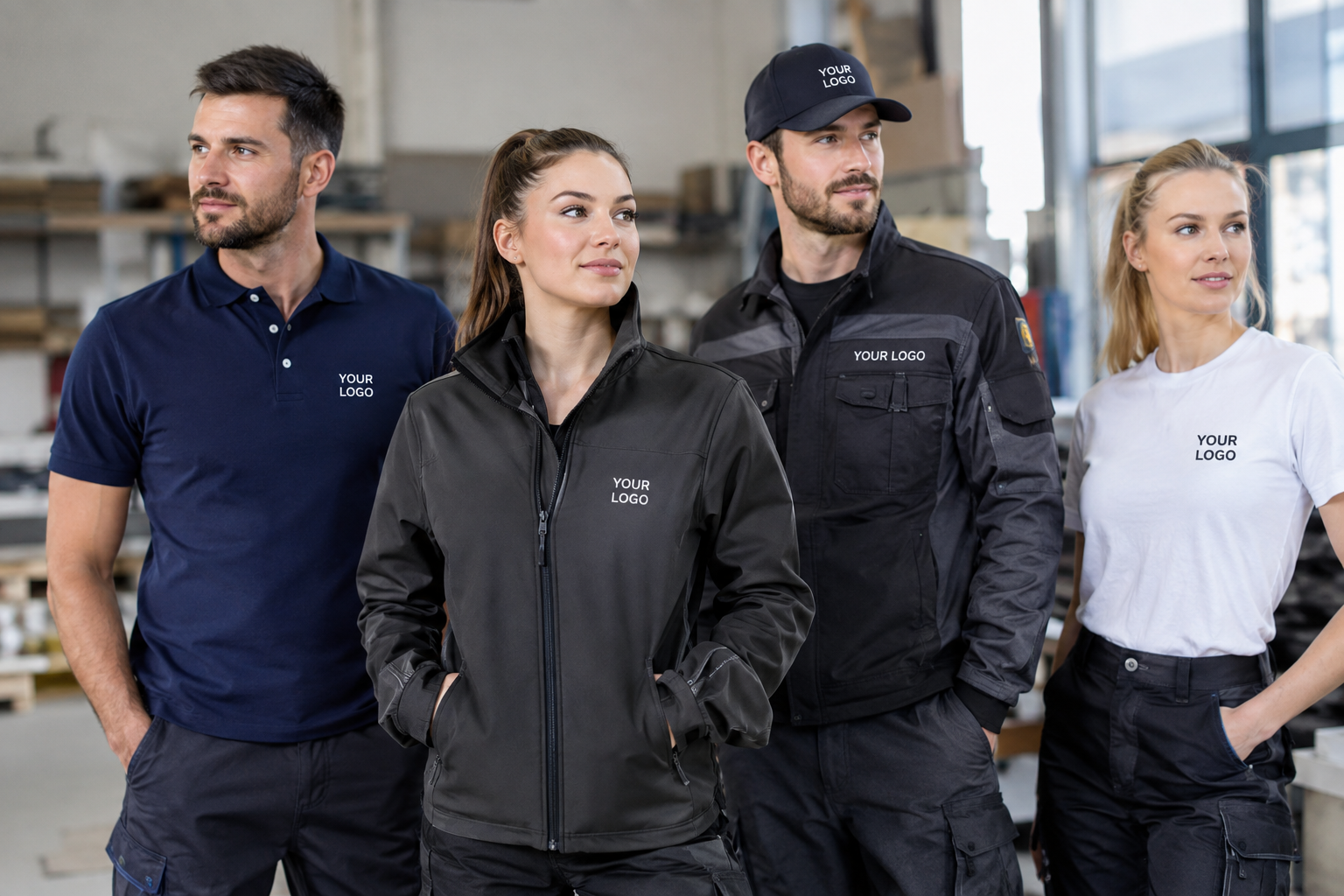
Custom workwear for businesses starts with the job itself
The same garment does not serve the same purpose in a warehouse, a restaurant and on a construction site. A polo shirt may be suitable for sales, service or reception staff, but inadequate for a team exposed to low temperatures, industrial traffic or fire hazards. Before customization, it is important to determine what each garment actually needs to do.
In construction, manufacturing, logistics and distribution, the priority is a combination of mobility, durability and visibility. Coveralls, work trousers, vests and jackets should be selected according to the level of wear, the season and the specific requirements of the job. If employees work near traffic or in low-light environments, high-visibility workwear is not a decorative element, but a safety measure.
In hospitality and catering, retail, services and corporate environments, presentation plays a greater role, but durability remains important. Shirts, aprons, polo shirts and sweatshirts need to maintain a consistent appearance after repeated washing while allowing employees to move naturally. For kitchen, hotel and cleaning staff, additional requirements may include resistance to stains, temperature, moisture and frequent washing.
In certain environments, workwear must be certified or designed to address specific risks such as rain, cold, fire, electrical arcs, hazardous substances or reduced visibility. This is not an area for improvising with promotional clothing. Personal protective equipment should be selected according to the risk assessment and the employee's duties, while the logo should be applied in a way that does not interfere with functional features or reflective areas.
The material determines how well the workwear will perform
Customization may look flawless when the order is delivered, but the material determines how the product will perform after months of use. Cotton is valued for its comfort and breathability, especially in T-shirts, polo shirts and sweatshirts. For activities involving heavy wear, cotton-polyester blends often provide a better balance between comfort, dimensional stability and resistance to repeated washing.
Polyester is useful for active teams, sports, logistics and activities where quick drying is important. However, it is not the ideal choice for every role or every employee preference. In warm environments, a fabric that is not breathable enough can become uncomfortable, causing employees to wear the uniform incorrectly or avoid it altogether. That is why fabric composition should be considered together with fabric weight, fit and season.
A work jacket needs to be assessed differently from a T-shirt. Wind and rain protection, thermal insulation, zipper durability, practical pockets and freedom of movement have a direct impact on productivity. Similarly, safety footwear should not be selected based on size alone: the sole type, toe protection, grip and working environment all matter throughout the shift.
We do not compete on the lowest price when the real cost appears after delivery. A cheaper product that needs to be replaced frequently because of weak stitching, unstable colors or damaged customization consumes both budget and administrative time. For businesses, cost per wear is a more useful criterion than the price per item.
The customization method should match the product and its use
The company logo is highly visible, but the technique used to apply it can make the difference between a uniform that lasts and one that looks worn after a short period of time. There is no universal customization method. The right choice depends on the fabric, placement, number of colors, graphic size and washing frequency.
Embroidery for a professional look and intensive use
Computerized embroidery is frequently recommended for polo shirts, shirts, sweatshirts, jackets, vests and caps. It has a premium appearance, remains stable over time and works particularly well with simple or moderately detailed logos. It is an effective option for service teams, sales representatives, hotels, restaurants and administrative staff.
However, embroidery is not the best choice for every graphic. A very small logo with fine lines or numerous details may need to be simplified in order to remain legible. On very lightweight fabrics, large embroidery can make the customized area feel stiff. In such situations, a printing method may provide a cleaner result.
DTG for detailed prints on cotton
DTG printing applies ink directly to the fabric and is particularly suitable for cotton or high-cotton-content T-shirts. It reproduces fine details, color gradients and complex graphic elements effectively. It is useful when the design is more than just a small chest logo and includes a larger graphic or a clear visual message.
The result depends on the quality of the textile, proper garment preparation and compliance with care instructions. For garments exposed to intensive friction or industrial washing, the most suitable alternative should be carefully evaluated.
DTF and heat transfer for greater flexibility
DTF allows colorful, detailed logos to be printed on a wide range of fabrics, including blends and polyester. It is a practical solution for visible branding on T-shirts, sweatshirts, jackets and other garments where embroidery is not the optimal choice. Heat transfer is suitable for text, names, numbers and functional markings and is frequently used for sportswear or employee identification.
For both methods, placement and application temperature are critical. Properly applied customization should remain securely attached, flexible and legible after repeated washing. Applying a logo to an area that bends constantly, rubs against equipment or comes into contact with strong sources of heat should be discussed before production.
How to build an efficient workwear order for your team
An efficient order starts with a clear structure based on employee roles. Not every employee needs the same products, but the uniform should maintain the same brand identity. For example, field teams may need jackets, vests and work trousers, while office or reception staff may wear polo shirts, shirts or cardigans in the same color palette.
It is useful to establish standard logo positions from the beginning: chest, sleeve, back or pocket. The size, contrast and legibility should then be checked for each product color. A dark logo on a dark jacket does little for the company's image, regardless of how well it is produced. The right contrast makes the brand recognizable from a distance without turning the uniform into a billboard.
Sizing is another critical point. Using size charts, fittings or sample garments helps reduce exchanges and delays. For larger teams, it is worth creating a role-based outfitting list including the product code, color, logo position and available size range. For future orders, this structure makes approval faster and helps maintain consistency.
For orders starting from 10 products, Zivara can help with product selection, choosing the right customization method and preparing an offer tailored to the order volume and complexity. Pre-production consultation is particularly useful when a company combines uniforms, PPE, seasonal workwear and promotional textiles in a single order.
What to check before giving final approval
Before production, check whether the selected product is suitable for the working environment, whether the artwork is available in a clear and appropriate format, and whether the proposed customization method matches the intended use. Confirm the colors, application positions, size distribution and the required delivery timeframe. For institutions and organizations with formal procurement procedures, technical documentation and compliance requirements should be reviewed before placing the order, not afterwards.
Good workwear is not only visible in a product photograph. You see it when an employee wears the uniform correctly, when the logo remains clear after repeated use and when the next order can be placed without uncertainty. Choose products and customization methods that support your team's work, not just its image.