
Your cart
There are no more items in your cart
- News
- 0 aprecieri
- 13 vizualizari
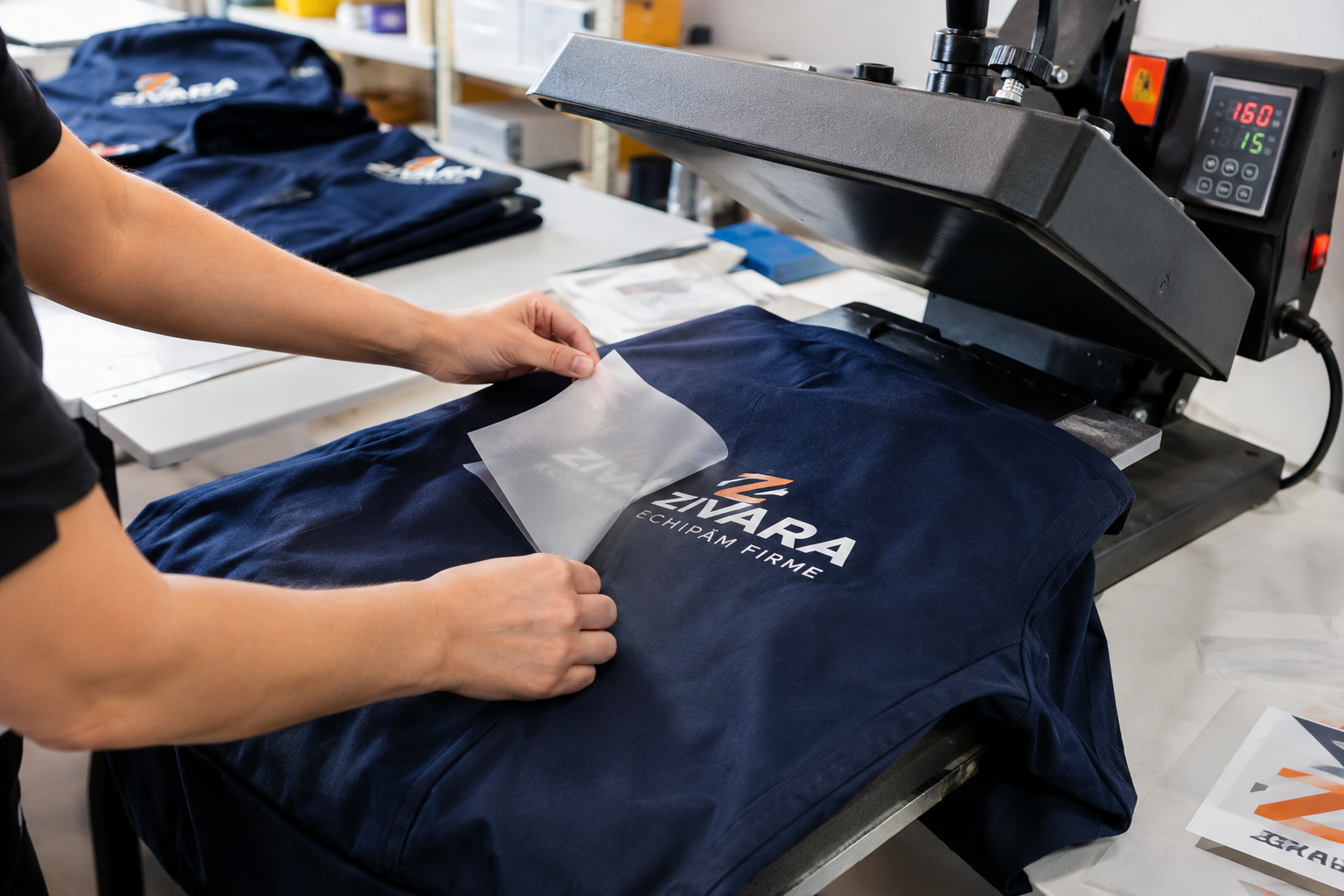
What Is Heat Transfer Printing and When Does It Work Best?
Heat transfer printing involves applying a cut or printed graphic to a special transfer material and bonding it to fabric using controlled heat, pressure and application time. Depending on the type of transfer film used, the result can be a single-colour logo, clear lettering, numbers, employee names or a full-colour design.
This method is particularly suitable for precise branding, areas where embroidery would add too much bulk, and garments that need to be customised quickly in small or medium production runs. It is commonly used on T-shirts, polo shirts, hoodies, softshell jackets and fleece garments, work jackets, overalls, aprons, sportswear and selected waterproof garments.
Its main advantage is precision. Fine lines, small lettering and brand colours can be reproduced cleanly without dense stitching. On a work T-shirt or the back of a work vest, a correctly applied logo can remain highly visible while maintaining a comfortable feel.
However, heat transfer printing is not a universal solution. When used on very thick fabrics, highly elastic materials, specially treated textiles or garments regularly exposed to high temperatures, choosing the right transfer film and application settings becomes essential. Not every film adheres to every fabric, and incorrect application can damage both the design and the garment.
When Should You Choose Heat Transfer Printing for Workwear?
Heat transfer printing is worth considering when your team needs branding that is clear, flexible and consistent across garments. For logistics, retail, maintenance, courier services, hospitality and field operations, this method allows different garment styles to be customised quickly while maintaining a consistent brand identity.
It works well for small chest logos, large back prints, individual employee names and team or department labels such as "Technical", "Maintenance", "Reception" or "Delivery". In these situations, embroidery may be more expensive, less flexible and less suitable for large lettering. Heat transfer printing provides a clean, uniform finish.
For companies employing seasonal workers or experiencing staff turnover, this method also offers operational advantages. Garments can be prepared in batches, with employee names or job titles added later without having to redesign the entire customisation project. This flexibility helps businesses manage stock and control costs.
On the other hand, embroidery may be the better option for formal uniforms, very thick fabrics or applications where a premium, textured finish and strong mechanical durability are priorities. There is no single customisation method that works best in every situation. The right choice depends on the garment and how it will be used.
Fabric Compatibility Matters More Than the Design
Cotton, cotton-polyester blends and many technical fabrics can work well with heat transfer printing when compatible transfer films are selected. Polyester, however, presents two practical challenges: dye migration from the fabric into the transfer, particularly on brightly coloured textiles, and the sensitivity of certain fabric finishes to heat. In these cases, suitable transfer materials and carefully controlled press settings are essential.
Softshell, fleece and waterproof fabrics require additional checks. Incorrect application temperatures can damage a membrane, affect a water-repellent finish or alter the garment's outer appearance. Before producing a full batch, it is advisable to test the transfer on the exact garment model rather than relying solely on a similar fabric sample.
For flame-resistant workwear, antistatic clothing and certified protective garments, customisation requires particular care. An incompatible application may affect the local performance of the fabric or the garment's intended protective properties. Logos should never be applied based on appearance alone, nor should they cover reflective tape or functional areas of the garment without confirming compatibility with the manufacturer's requirements.
Heat Transfer Durability Starts Before Application
A durable heat transfer is about more than choosing a high-quality film. It depends on a series of correct decisions: compatible fabric, properly prepared artwork, the right temperature, even pressure, accurate pressing time and cooling in accordance with the transfer manufacturer's instructions. If any of these factors is overlooked, the edges may lift, colours may lose intensity or the design may crack prematurely.
Placement also matters. A logo positioned in an area subject to constant friction from a belt, harness, backpack or work equipment will experience greater wear. On the same jacket, a chest logo may last differently from a large transfer on the lower back. For construction, maintenance and transport teams, these details can make a practical difference.
Care instructions directly affect the lifespan of customised workwear. As a general rule, garments should be washed inside out, at the temperature recommended for the garment and transfer, and without aggressive cleaning agents that may damage the printed surface. Excessive heat during drying and direct ironing over the logo should be avoided. These instructions should be communicated clearly to employees, especially when uniforms are washed individually rather than by a professional laundry service.
Heat Transfer vs DTF Printing vs Embroidery
It is easy to confuse these methods because all three can be used to customise the same garment. The differences become clearer when you consider the intended application. Traditional heat transfer vinyl is particularly effective for vector logos, lettering, solid colours and designs with clearly defined shapes. Depending on the material selected, it can provide good stretch and opacity, including on dark fabrics.
DTF (Direct to Film) printing is a strong option for designs featuring gradients, very fine details, photographic elements or multiple colours. The printed design is transferred to the garment using heat, but the printing process makes it possible to reproduce more complex artwork than a standard cut vinyl design. DTF may therefore be more suitable for detailed brand graphics and promotional visuals.
Embroidery remains an excellent option for polo shirts, shirts, heavyweight hoodies, work vests and jackets where a raised texture, premium appearance and good mechanical durability are desired. However, it has limitations when it comes to very small details, large designs or delicate fabrics. In some areas, stitching may also feel less comfortable than a well-selected heat transfer.
The decision should not be based on general preferences alone. A small chest logo on a polo shirt may look excellent when embroidered, while the same brand identity displayed across the back of a work vest may be more practical using heat transfer printing. Combining different customisation methods is often the best way to achieve a consistent professional appearance across a company's workwear.
What Should You Confirm Before Placing an Order?
Before placing an order for at least 10 customised garments, it is useful to confirm a few key details: the garment model, fabric composition, available colours, logo placement, required dimensions and actual working conditions. A warehouse team has different requirements from kitchen staff, an automotive workshop or an outdoor team working in rain and cold weather.
Artwork should ideally be supplied in vector format or as a high-resolution file. A logo taken from a small image on the internet may look unclear regardless of the customisation method used. If your brand identity requires specific colours, these should be discussed in advance because the final appearance depends on the transfer material and the colour of the garment underneath.
At Zivara, our recommendations start with the garment and the team's working conditions, not with the customisation method that is easiest to sell. A work jacket, a promotional T-shirt and a high-visibility vest require different considerations. Customisation should support the product's intended use, not compromise its value.
A correctly applied logo becomes part of the workwear: it helps identify the team, reinforces company standards and makes the business recognisable wherever its employees work. Choose heat transfer printing when it delivers the right combination of clarity, comfort and durability for the garment in question. Before production, always check the compatibility of the fabric, transfer material and actual working conditions.